
Car Shipping Cost Calculator: See Your Real Price Instantly — No Email Required
Enter your route, vehicle, and transport type to get a real 2026 price range in seconds — not a lead-gen guess.
Get Your Free Car Shipping Quote
Open Carrier · Most Affordable
How Much Does It Cost to Ship a Car?
On average, shipping a car across the U.S. costs between $600 and $1,500, depending mainly on distance, vehicle type, and transport method. Short-distance moves (under 500 miles) typically run $400–$700, medium-distance routes (500–1,500 miles) average $700–$1,100, and long-distance or coast-to-coast shipments (1,500+ miles) generally cost $1,000–$1,800.
| Distance | Open Transport | Enclosed Transport |
|---|---|---|
| Short (under 500 mi) | $400 – $700 | $650 – $950 |
| Medium (500–1,500 mi) | $700 – $1,100 | $1,000 – $1,500 |
| Long (1,500+ mi) | $1,000 – $1,800 | $1,500 – $2,500 |
These are typical market ranges — your exact rate depends on the specific factors below. Use the calculator above for a quote tailored to your vehicle and route.
What Affects Your Car Shipping Cost
Distance & Route
Longer routes cost more in total but less per mile. A 200-mile trip might cost $1.50–$2.50 per mile, while a 2,500-mile cross-country move often drops to $0.50–$0.80 per mile. Popular corridors with heavy carrier traffic (like California–Texas or Florida–New York) tend to price lower than remote or less-traveled routes.
Vehicle Size & Weight
Larger, heavier vehicles take up more space on a carrier and cost more to move. A standard sedan sits at the low end of pricing; SUVs and trucks run 10–20% higher; oversized vehicles (vans, dually trucks, RVs) can add 25% or more.
Vehicle Condition
Running vehicles are the cheapest to ship since they load and unload under their own power. Non-running vehicles require a winch and extra labor, typically adding $100–$200 to the base rate.
Transport Type
Open transport is the standard, most affordable option — used for roughly 90% of shipments. Enclosed transport, which fully shields the vehicle from weather and road debris, typically costs 40–60% more but is the standard choice for luxury, classic, and exotic vehicles.
Season & Demand
Prices fluctuate with seasonal demand. Snowbird season (Oct–Nov and Mar–Apr, as retirees relocate between the Northeast/Midwest and Florida/Arizona) and peak summer moving months see higher rates due to carrier demand. Shipping in off-peak months can save 10–15%.
Pickup & Delivery Type
Door-to-door service (the carrier picks up and delivers directly to your addresses) is the most convenient and most common option, included in most quotes at no extra cost. Terminal-to-terminal service, where you drop off and collect from a depot, can save a small amount but adds logistics on your end.
Insurance & Fees
All shipments through our network include cargo insurance in the base quote — no separate line-item cost to you. Some competitors add pickup fees or fuel surcharges after the fact; our instant quotes are all-inclusive with no hidden charges.
Shipping Cost by Vehicle Type
| Vehicle Type | Typical Additional Cost | Notes |
|---|---|---|
| Sedan | Baseline | Fastest to load, lowest cost |
| SUV / Minivan | +10–15% | Slightly more space required |
| Pickup Truck | +15–20% | Higher for full-size/dually |
| Motorcycle | −30–40% (lower base) | Often shipped via crate or dedicated carrier |
| Non-Running Vehicle | +$100–$200 flat | Requires winch equipment |
| Classic / Exotic / Luxury | +40–60% | Enclosed transport strongly recommended |
| Oversized (RV, Boat, Van) | +25% or more | May require specialized carrier |
Have a specific vehicle in mind? Our Motorcycle Shipping, SUV & Truck Shipping, Non-Running Vehicle Transport, and Classic & Exotic Car Transport pages break down pricing and process in more detail.
Open vs. Enclosed Transport: Cost Comparison
| Open Transport | Enclosed Transport | |
|---|---|---|
| Typical Cost | Baseline | +40–60% |
| Protection | Exposed to weather/road debris | Fully enclosed, weatherproof |
| Best For | Everyday vehicles, budget-conscious moves | Classic, luxury, exotic, or high-value vehicles |
| Usage | ~90% of all shipments | ~10% of shipments |
Most vehicle owners choose open transport — it's safe, standard across the industry, and the same method used to move cars to dealerships nationwide. Enclosed transport is worth the premium when a vehicle's value or rarity makes weather and debris exposure a real risk. See our full Open Auto Transport and Enclosed Auto Transport pages for details.
How Long Does Car Shipping Take?
| Distance | Standard Transit Time |
|---|---|
| Under 200 miles | Same day – 1 day |
| 200–500 miles | 1–2 days |
| 500–1,500 miles | 2–4 days |
| 1,500–2,500 miles | 4–7 days |
| Coast-to-coast (2,500+ mi) | 7–10 days |
Need it faster? Our Expedited Auto Transport service offers priority dispatch and shortened transit windows for time-sensitive moves, typically at a 15–25% premium over standard rates.
How This Calculator Works
Unlike most car shipping calculators, which require your name, email, and phone number before showing a single number, this calculator shows you a real price range immediately, based on your actual route, vehicle, and transport type — no contact information required. You only share your details afterward, if you want a locked, bookable quote from a real carrier.
No — you don't need to provide an email or phone number to see your car shipping cost estimate. This calculator shows a real price range instantly based on your route and vehicle details. Contact information is only needed if you choose to book a locked quote with an actual carrier.
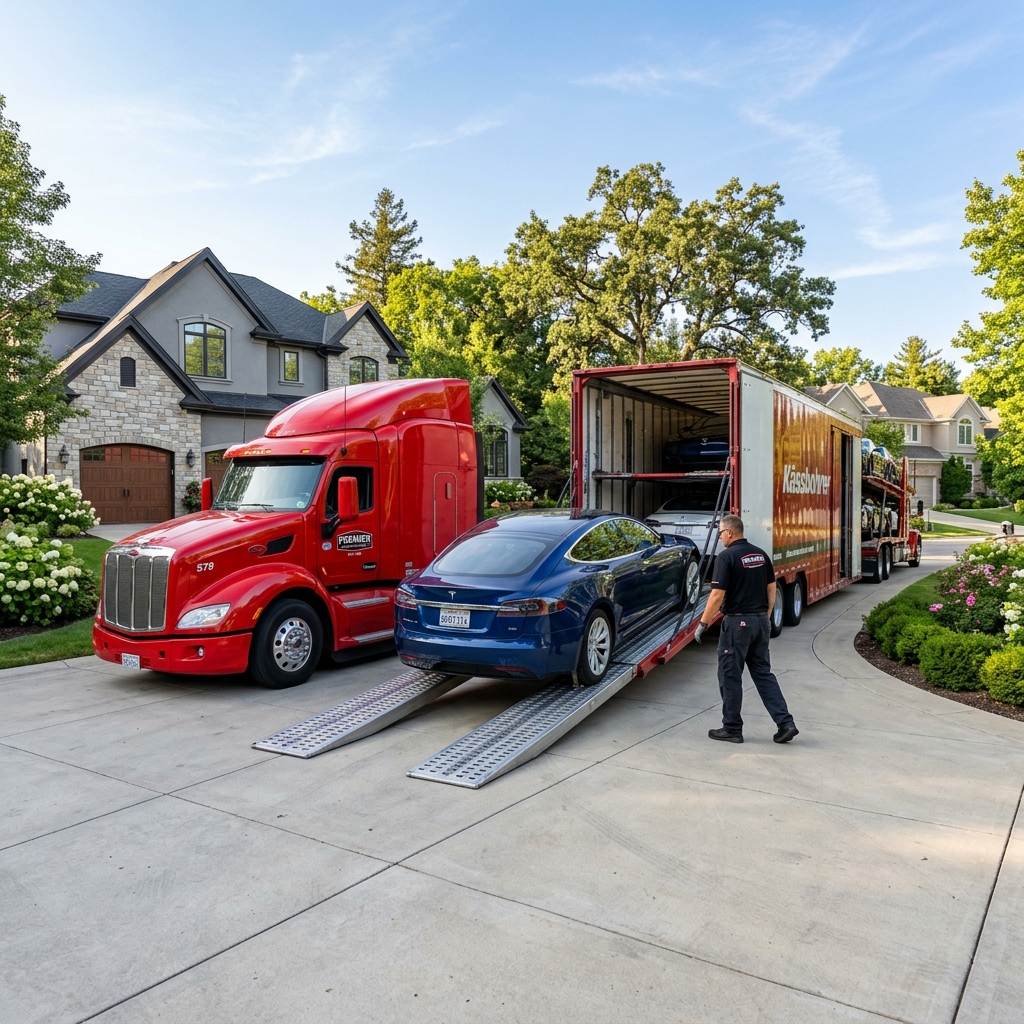
Instant car shipping cost estimates without forced contact details or lead-gen gates.
How Car Shipping Cost Is Actually Calculated
Most calculators list pricing "factors" without showing how much each one actually moves your price. Here is a transparent, worked example:
Chicago, IL → Houston, TX (1,085 miles) · 2023 Honda CR-V · Open Transport
| Cost Factor | Baseline Impact |
|---|---|
| Base distance rate (medium-haul) | ~$0.75–$0.95/mile → ~$850 baseline |
| Vehicle size (SUV vs. sedan) | +$100–$200 |
| Season (if booked in peak summer) | +5–15% |
| Pickup flexibility (fixed vs. flexible) | +10–20% if fixed date requested |
| Typical Final Range | $790 (avg.) — see live calculator above |
The 6 Factors That Actually Move Your Price
- Distance — the single biggest factor; cost per mile drops as total distance increases
- Vehicle size & weight — SUVs and trucks typically cost $100–$400 more than a sedan
- Transport type — enclosed transport runs 30–60% more than open transport
- Season & demand — summer and "snowbird season" (fall/winter migration to FL/AZ) raise prices; off-peak months are cheaper
- Vehicle condition — non-running vehicles typically add $150–$300 for special loading equipment
- Pickup flexibility — a flexible 3–5 day pickup window can save 10–20% versus requesting an exact date
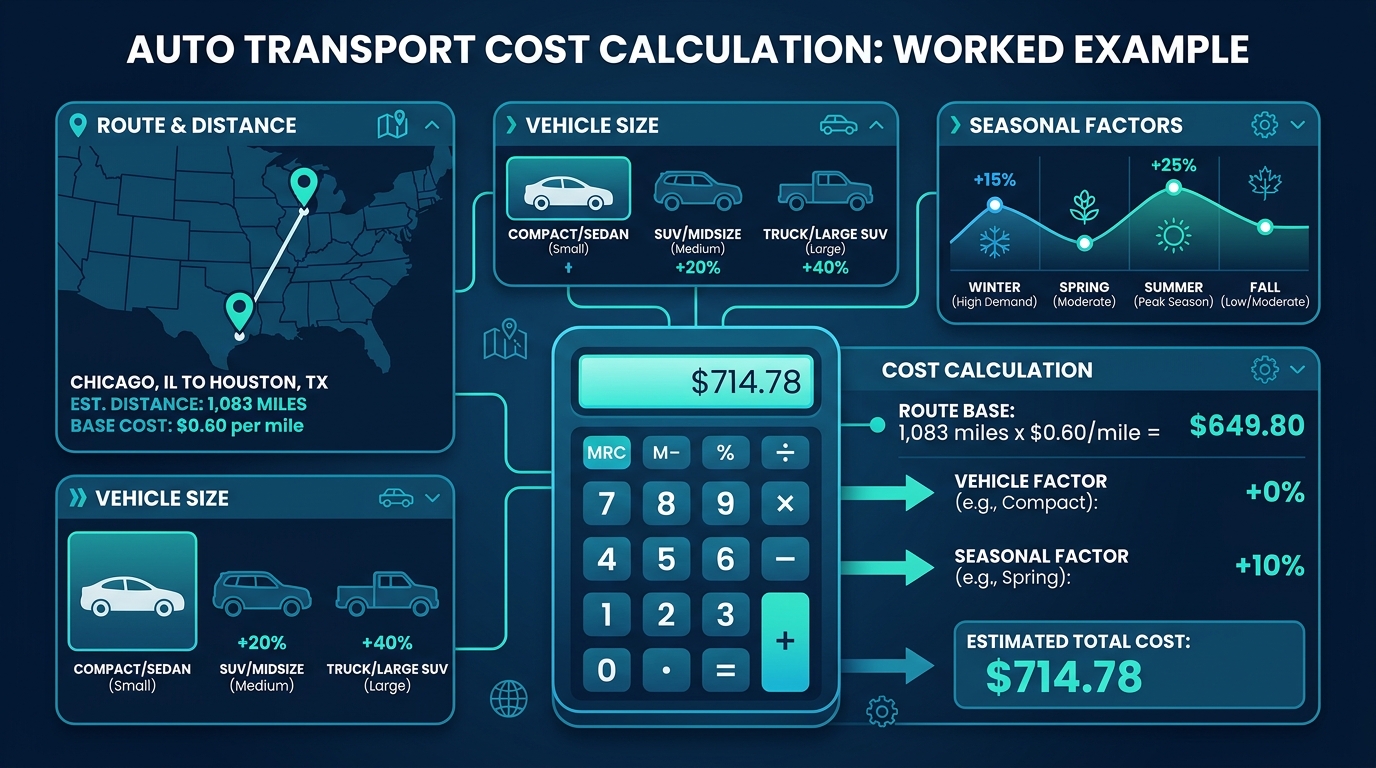
Worked example showing how car shipping cost is calculated from distance, vehicle size, and season.
Average Car Shipping Cost by Distance (2026)
Standard baseline pricing tiers for operable sedans on open transport nationwide.
| Distance Tier | Typical Cost Range | Approx. Cost Per Mile |
|---|---|---|
| Under 500 miles (Short-haul) | $400 – $850 | $1.20 – $2.00 |
| 500 – 1,500 miles (Mid-haul) | $700 – $1,250 | $0.70 – $1.00 |
| 1,500+ miles (Cross-country) | $1,000 – $1,800 | $0.40 – $0.70 |
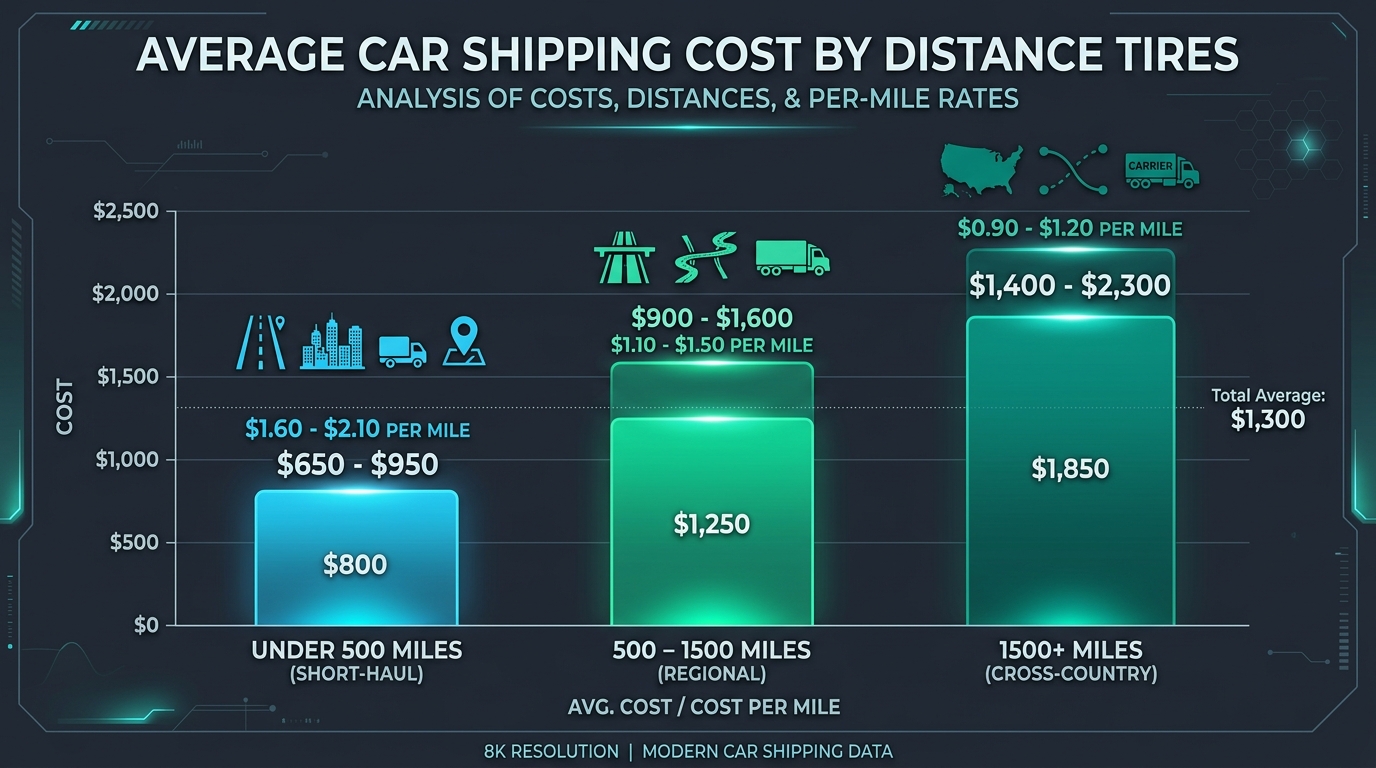
Chart showing average car shipping cost by distance in 2026.
Car Shipping Cost by Vehicle Type
How vehicle size, weight, and powertrain impact carrier loading and pricing.
| Vehicle Category | Typical Cost Adjustment vs. Sedan |
|---|---|
| Sedan | Baseline |
| SUV | +$100 – $200 |
| Truck | +$150 – $400 |
| Motorcycle | Typically less than a sedan |
| Non-running vehicle | +$150 – $300 (any vehicle type) |
| Electric Vehicle (EV) | +$150 – $300 (added weight from battery pack) |
Electric vehicles typically cost $150–$300 more to ship than an equivalent gas vehicle, due to added weight from the battery pack, which affects trailer capacity and axle weight limits. The transport process itself is the same as shipping any other vehicle — no special handling is required for shipping, only for weight-based pricing.
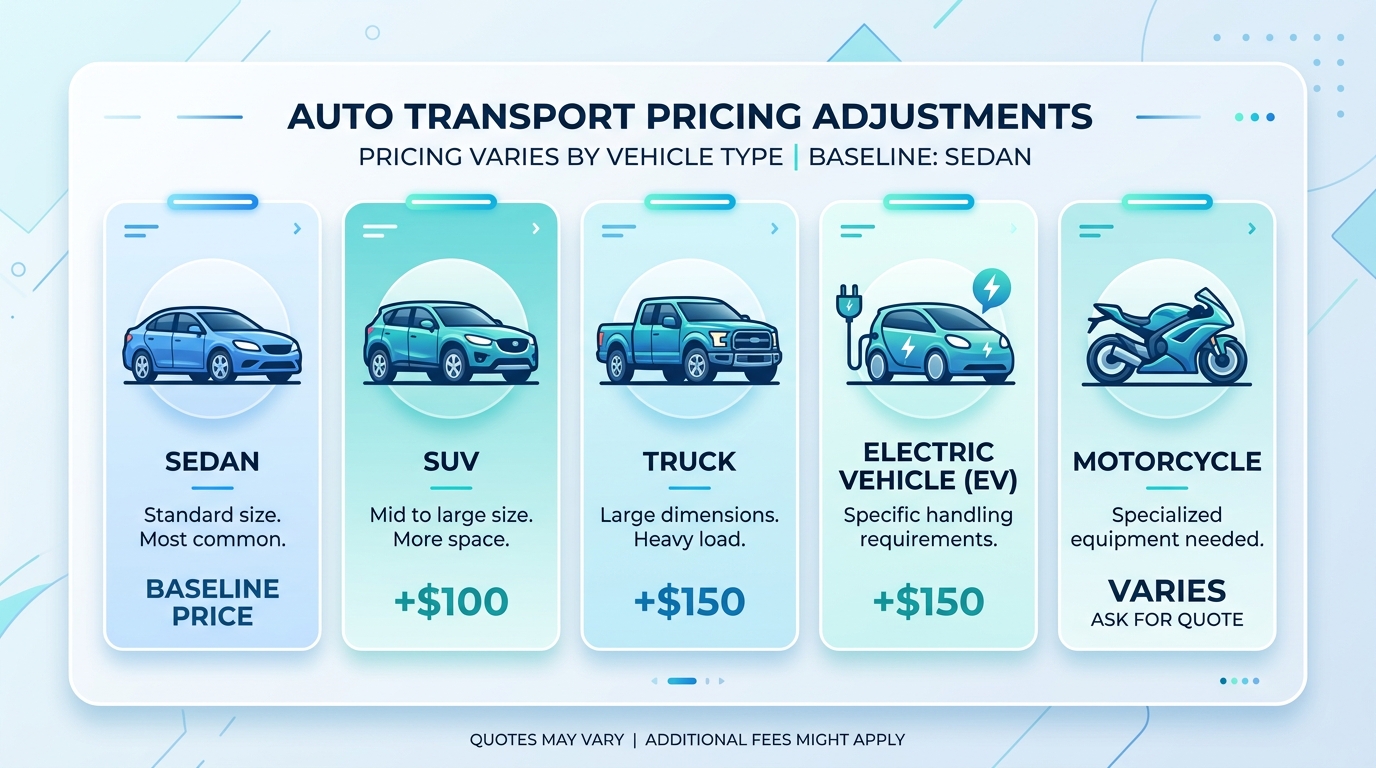
Comparison chart of car shipping cost by vehicle type including sedan, SUV, truck, and EV.
Open vs. Enclosed Cost Comparison
Comparing open multi-car carriers with fully enclosed weather-protected transport.
| Transport Type | Typical Cost Range | Best For |
|---|---|---|
| Open Transport | $400 – $1,800 | Standard vehicles, lowest cost |
| Enclosed Transport | $600 – $3,100 | Classic, exotic, luxury, high-value vehicles |
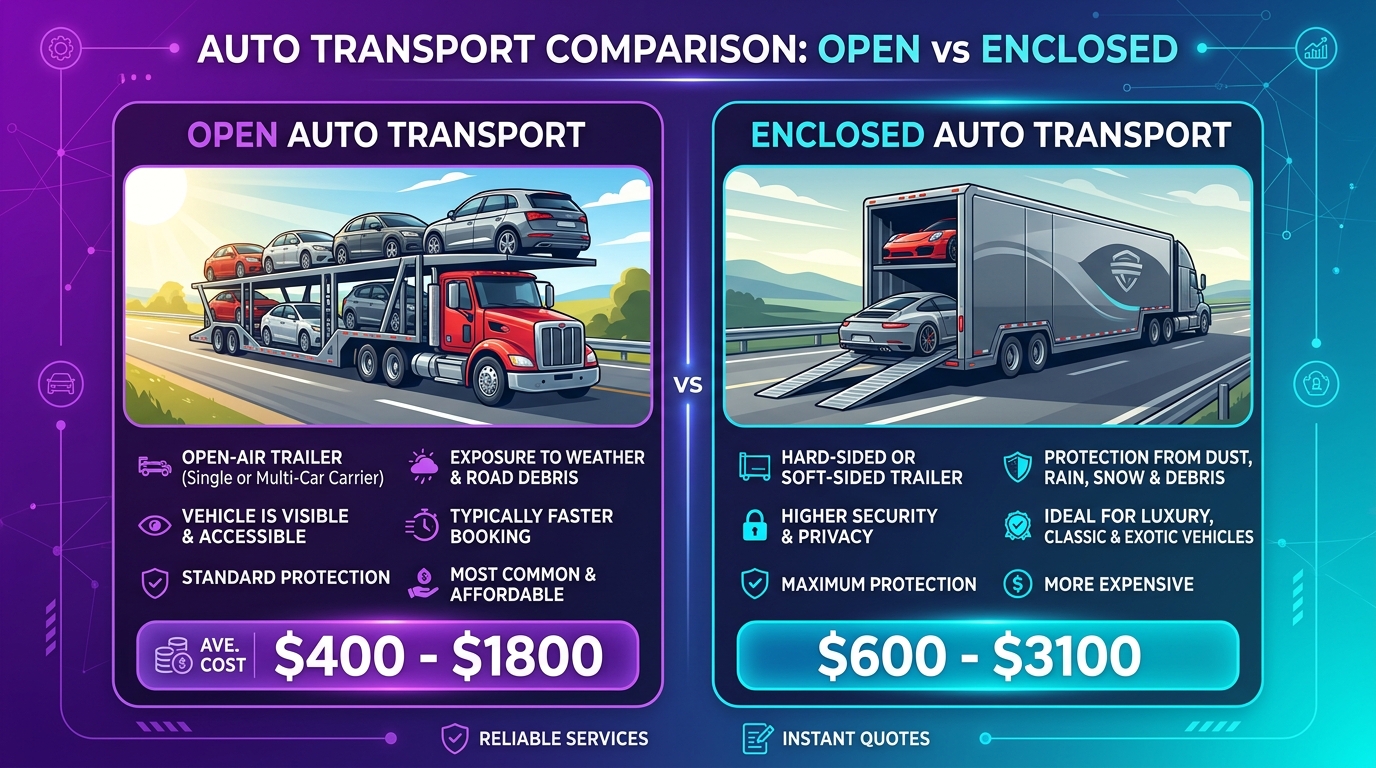
Cost comparison chart of open versus enclosed car shipping in 2026.
How to Save Money on Car Shipping
Practical strategies to lower your vehicle shipping quote without compromising safety or reliability.
Choose Open Auto Transport
Open carrier shipping is 30% to 60% cheaper than enclosed transport and handles over 90% of all vehicle shipments in the U.S.
Book 1–2 Weeks in Advance
Advance booking gives dispatchers time to pair your vehicle with trucks already running your route, avoiding expensive last-minute expedited surcharges.
Be Flexible on Pickup Dates
Allowing a 3 to 5-day pickup window instead of demanding an exact date saves 10% to 20% on carrier dispatch rates.
Ship Outside Peak Seasons
Summer relocation months and fall/spring snowbird migrations drive up prices. Late winter and early spring offer the lowest baseline rates.
Ensure Vehicle is Operable
Non-running vehicles require winches and special loading equipment, adding $150 to $300. Inflate tires and fix minor starting issues beforehand.
Choose Zero-Deposit Brokers
Avoid paying upfront fees before a carrier is assigned. America Car Transport never charges upfront deposits until your driver is confirmed.
Is This Estimate Binding?
This calculator provides a real, data-driven planning range — not a final, binding price. Your exact quote depends on live carrier availability on your specific route at the time of booking. Once you request a formal quote, America Car Transport locks in a firm price with zero upfront deposit required.
Frequently Asked Questions
Direct, extractable answers optimized for Featured Snippets and AI Overview citation.
Is shipping my car cheaper than driving it myself?
Often, yes — once you factor in gas, meals, lodging, mileage wear, and your own time, shipping is frequently more cost-effective for trips over 750–1,000 miles, especially for a second or non-daily vehicle.
What's the cheapest way to ship a car?
Open transport on a standard (non-expedited) timeline, booked during off-peak season, along a high-traffic corridor (like major interstate routes), is typically the lowest-cost option.
Can I get an instant quote without a phone call?
Yes — our calculator above gives you a real-time estimate based on your route, vehicle, and transport type with zero obligation and no call required.
How is my shipping quote calculated?
Your quote is based on five main factors: distance, vehicle type/size, condition (running or non-running), transport type (open or enclosed), and current seasonal demand along your route.
Does the price change by season?
Yes. Snowbird season (fall and spring) and peak summer relocation months typically see 10–20% higher demand-driven pricing. Booking in off-peak months can lower your rate.
Can I get a quote by ZIP code instead of city?
Yes — the calculator accepts ZIP codes for both pickup and delivery locations for a more precise, address-level estimate.
Is my quote the final price I'll pay?
Our quotes are all-inclusive of standard cargo insurance and door-to-door service, with no hidden pickup or fuel surcharge fees added later.
How much does it cost to ship a car 2,000 miles?
A 2,000-mile move — a typical West Coast-to-Midwest or West Coast-to-Northeast distance — generally runs $1,000 to $1,600 on open transport for a standard sedan or midsize SUV, with enclosed transport typically adding 40–60% on top of that. Long-haul routes like this actually carry a lower per-mile rate than short hauls, since fixed costs spread across more miles. For a number tied to your real ZIP codes, use our Cost Calculator for an instant estimate with no email required.
How much does it cost to ship a car 200 miles?
Short hauls under 200–300 miles typically cost $300 to $600, but carry the highest per-mile rate of any distance tier because loading, dispatch, and minimum-trip costs don't shrink with distance. Routes between major metro pairs (e.g., Los Angeles to San Diego, Dallas to Houston) tend to price toward the lower end of this range due to consistent carrier traffic.
How long does it take to ship a car 1,000 miles?
A 1,000-mile shipment typically takes 3 to 5 days in transit, plus a pickup window of 1–3 days between booking and an available carrier arriving — so total door-to-door time usually lands between 4 and 8 days.
What is the cheapest way to ship a car within the USA?
Open, terminal-to-terminal transport booked outside peak season with a flexible pickup window is consistently the lowest-cost combination for owners who don't need door-to-door convenience or enclosed protection.
Is it cheaper to ship a car by ground or air?
Ground transport by truck is dramatically cheaper and the default choice for shipping a car within the continental United States. Air freight costs several times more per mile and is used almost exclusively for overseas relocations or high-value show cars.
How do you calculate car shipping cost?
Car shipping cost comes down to five factors multiplied together, not a flat per-mile rate: distance, vehicle size/weight, transport type (open vs. enclosed), route popularity, and timing. Distance sets the baseline, but it isn't linear — short hauls under 300 miles carry a higher per-mile rate than long-haul routes. Larger vehicles cost more due to space and weight on the trailer, enclosed shipping adds 40–60%, and peak seasonal demand (summer and fall snowbird season) raises rates.
How can I save money on car shipping?
The four highest-impact levers are: book outside peak season (late winter/early spring offers lowest rates), choose open over enclosed, choose terminal-to-terminal over door-to-door, and stay flexible on pickup date (a 1–3 day window costs less than an exact-day demand).
How much does it cost to ship a car from California to New York?
A California-to-New York move — roughly 2,800 miles, one of the longest common domestic routes — typically runs $1,100 to $1,600 on open transport for a standard sedan or midsize SUV, with enclosed transport adding roughly 40–60% on top. Explore our California Car Shipping Guide for state-specific details.
How much is it to ship a car from California to Florida?
California to Florida — about 2,500 to 2,800 miles — typically costs $1,000 to $1,500 on open transport for a standard vehicle. View complete pricing tables, transit times, and train shipping fact-checks on our dedicated California to Florida Route Page.
How much does it cost to ship a car from Florida to New York?
Florida to New York — roughly 1,100 to 1,300 miles — typically runs $700 to $1,050 on open transport for a standard vehicle, sitting in the mid-distance range where per-mile cost is lower than a short in-state move but higher than a true cross-country haul.
Is shipping a car a good idea?
For most people relocating more than a few hundred miles, yes — shipping is generally the more practical option once total cost, time, and vehicle wear are weighed against driving it yourself. The math tends to favor shipping past roughly 300 miles: driving racks up fuel, meals, hotel nights, and extra mileage-related wear on the vehicle, plus the value of the days spent behind the wheel instead of settling into a new home or job.
Do cars get damaged in shipping?
Damage is uncommon but not zero — the large majority of vehicles arrive with no new damage, and when something does happen it's typically minor (a small chip or scuff) rather than significant. Enclosed transport lowers this risk further for owners of classic, exotic, or high-value vehicles.
Do you need insurance when shipping a car?
You don't need to buy separate insurance — licensed carriers are required to carry cargo insurance covering your vehicle while it's on the truck — but you do need to confirm the coverage is real and adequate before booking. Read our complete guide at How to Avoid Car Shipping Scams.
What should I do before I ship a car?
Four things matter most: clean the car, document its condition with dated photos/video from all angles, remove personal belongings and valuables, disable any aftermarket alarm, and leave the gas tank around a quarter full.
What do I need to know before shipping a car?
Three expectations to set going in: pricing varies by route, season, and transport type rather than being a fixed number; a reputable carrier won't demand a large upfront deposit; and the Bill of Lading is the document that actually protects you.
What is the cheapest company to ship your car?
There's no single “cheapest” company across every route and season, because auto transport pricing is dynamic — it moves with fuel prices, carrier availability, and how many trucks are already running your specific route that week. A zero-upfront-deposit policy and verified USDOT/MC licensing are better predictors of a fair, honest price than a marketing claim of “cheapest.”
How can I avoid the car delivery fee?
If this is about a new car's manufacturer destination/delivery fee, it cannot be avoided — it is a non-negotiable charge itemized by law on window stickers. For auto-transport delivery costs, choosing terminal-to-terminal over door-to-door service avoids the extra charge of routing a truck to a residential address.
Does the Navy ship your car for free?
Yes, but only for active-duty service members (Navy included) with PCS orders to an overseas (OCONUS) duty station, who are authorized to ship one privately owned vehicle at government expense. CONUS-to-CONUS moves are generally self-funded.
Is it worth it to ship an old car?
Usually yes, as long as the shipping cost stays reasonable relative to the car's value and the reason for the move is real. For a car worth only a few thousand dollars, compare the shipping quote against selling locally and buying a replacement at your destination.
Do USPS ship cars?
No — the U.S. Postal Service doesn't ship vehicles; its network is built for mail and parcels. Shipping a vehicle requires a licensed auto transport carrier using specialized flatbed or multi-car trailers. Claims that USPS ships cars are a common scam sign.
What is the safest way to ship a car?
Enclosed transport with a verified, licensed, and insured carrier ( | ) is the safest combination available, protecting against road debris and weather.
How much does it cost to ship a car from Florida to Chicago?
Florida to Chicago — roughly 1,100 to 1,200 miles — typically costs $650 to $950 on open transport for a standard sedan or midsize SUV.
Get a Locked, Bookable Quote
Ready for a firm price? Get a locked quote from a real carrier — zero upfront deposit.